
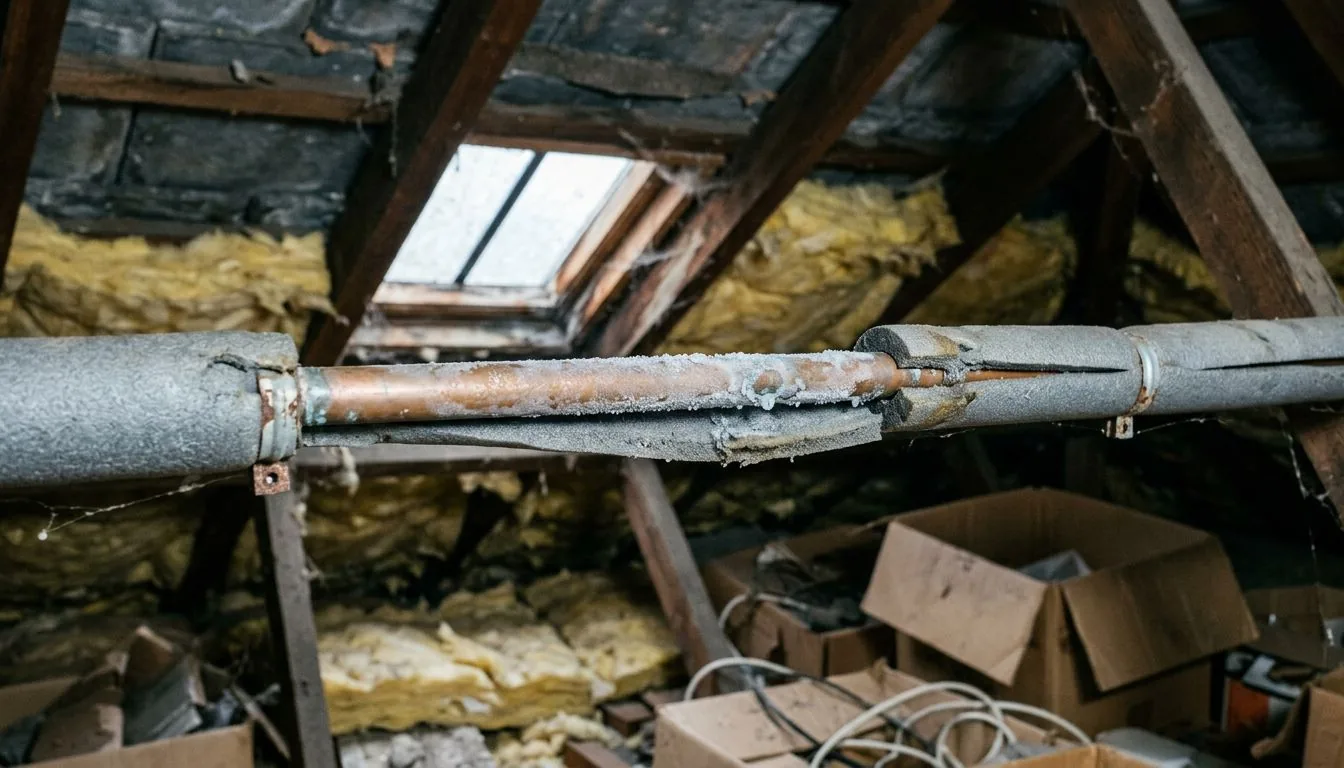
Water expands by about nine per cent when it freezes. Inside a copper or plastic pipe, that swelling has nowhere to go. As a result, the pressure builds until the pipe splits. You often only find out once the ice melts and water starts pouring out. This guide follows Met Office advice on preventing and thawing frozen pipes. It explains how to protect your home before the next cold snap. It also explains how to act safely if a pipe does freeze.
Why frozen pipes cause damage
A frozen pipe does not always burst straight away. The split usually happens along the section of pipe where ice has formed. However, the leak may not show until the ice thaws and water pressure returns to normal. That is why a "frozen pipe" and a "burst pipe" event often overlap. You can have days of frozen taps followed by sudden flooding once the temperature rises again.
Which pipes are most at risk
Pipes in unheated spaces are the ones to watch. Think lofts, garages, cellars, and any run of pipework against an external wall. Similarly, outdoor taps and their supply pipes are also common failure points. This also includes pipework under kitchen or bathroom floors in an extension. That pipework was not insulated properly when it was built.
How to prevent frozen pipes
Insulate exposed pipework
The Met Office recommends making sure "all pipes in your roof space or loft, as well as pipes in other areas that may be vulnerable to the cold, are insulated". Foam pipe lagging is cheap, and a few hours with a tape measure and a hobby knife can cover most of a loft. In particular, don't forget the cold water tank itself, if you have one, and any pipework running through an unheated garage.
Keep some warmth in the house
If you are heading away for a break in winter, the Met Office advises that you "leave your heating on low". That's rather than switching it off completely. A background temperature stops pipes inside the building from reaching freezing, even while you are not there to notice a problem. Similarly, leaving loft hatches and cupboard doors under sinks open a crack can also help warm air reach vulnerable pipework.
Know where your stop tap is
Every home has a stop tap that shuts off the mains water supply. The Met Office's advice is blunt. Check it works every six months, and make sure everyone in the house knows where it is. You do not want to be searching for it for the first time while water is already spreading across the kitchen floor. Our guide on how to find your stop tap covers the likely locations room by room.
How to thaw a frozen pipe safely
If a tap has stopped running and you suspect a frozen pipe, don't panic. Avoid reaching for anything with a flame.
Step 1: turn off the stop tap first
Before you try to thaw anything, turn off the stop tap. If the pipe has already split under the ice, this limits how much water escapes once it thaws. As a result, it is far easier to do this now than after water starts coming through a ceiling.
Step 2: relieve the pressure
Next, open the nearby cold tap that the frozen section feeds. In particular, the Met Office notes that this "will relieve pressure on the frozen pipe" as it thaws, which reduces the chance of a split widening.
Step 3: apply gentle, even heat
Warm the pipe slowly. The recommended method is a hot water bottle held against the pipe, or towels soaked in hot water and wrapped around it. Work along the pipe from the tap end towards the blockage, rather than heating the middle first. Similarly, a hairdryer on a low setting, moved constantly along the pipe, is also a reasonable option if you have one to hand.
What never to do
Never use a naked flame or a blowtorch on a frozen pipe. The Met Office is direct about the risk: "direct heat may cause permanent damage to the pipes and could also lead to a fire in the home". However, older lead or soldered joints and nearby timber or insulation can ignite or melt long before the ice does.
Avoid electric heaters pointed directly at plastic pipework too. Similarly, even without a flame, concentrated heat can warp or scorch a pipe rather than thaw it evenly.
If the pipe has already burst
Sometimes the split only becomes obvious once the thaw begins, and water starts running from a joint or a crack the ice had hidden. If that happens, keep the stop tap off and mop up what you can. Mark your request as urgent if water is still escaping when you fill in our request form for an engineer.
Our guide on what to do in the first 10 minutes after a pipe bursts walks through the whole sequence. In particular, it covers what to do about electrics near the water.
A repair to a burst section of pipe usually needs a plumber rather than a DIY fix. This is particularly true if a wall or floor conceals the pipe. However, you can read more about the process on our burst pipe repair page.
Preparing for the next cold snap
Once a plumber has repaired a frozen pipe, it is worth checking why it froze. In particular, a section that froze once is likely to freeze again, unless it gets extra insulation. Rerouting it away from an external wall also helps.
Homes in cold, exposed parts of the region need to take this more seriously than most. In particular, rural and exposed properties covered by emergency plumber cover in Cannock often have outbuildings and long pipe runs. They should check loft and garage pipework before the first frost rather than after it. The same applies to homes around Codsall.
The same goes for older housing stock in the Wednesbury area. Original pipework there sometimes runs close to an external wall, with only plaster between it and the cold. As a result, a short check now is far cheaper than a burst pipe repair in January.
Related reading
If a pipe has already split, our guide on what to do in the first ten minutes after a burst pipe is the next step. However, once the immediate danger has passed, many people then ask about the cost of the repair. We cover that in drain unblocking cost in the West Midlands and leak detection cost and what trace and access covers.
It is also worth reading are burst pipes covered by home insurance? before the weather turns, so you know what your policy is likely to expect from you. Additionally, for a wider view of drain and pipe problems that can follow a hard winter, see who is responsible for a blocked drain in Wolverhampton? and blocked drain outside your house: safe first checks.
You can browse the full list of local pages to see whether your area has its own page. It has more detail on cover and services.