
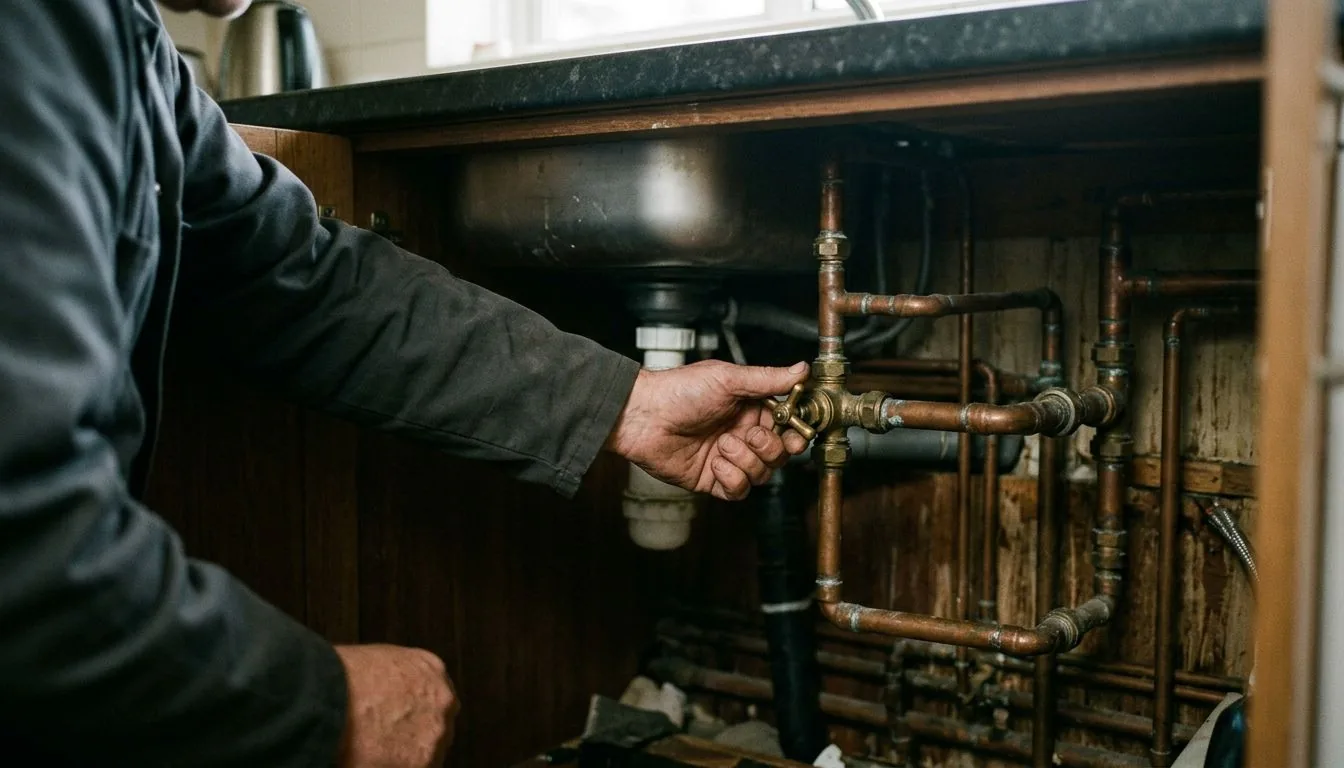
Most people only think about their stop tap once. That's usually during an emergency, with water pouring across the floor and no idea where to look. It's worth five minutes now to find yours instead. Knowing its exact location in advance turns a panicked search into a ten-second job when it actually matters.
What is a stop tap?
A stop tap, also called a stopcock, is the valve that controls water flowing into your home's plumbing system. Turning it off cuts the water supply to every tap, toilet and appliance in the property. That's because it's the single point everything runs through. That's exactly what you want during a burst pipe or a major leak.
It isn't something you use day to day. So unless you've had reason to look for it before, there's a good chance you've never seen it.
What does a stop tap look like?
Inside a home, a stop tap is usually a small valve on a section of pipe. Although it often has a round or lever-style handle rather than a wheel, most are a simple tap-like handle you turn by hand.
Older ones sometimes need a small key or a firm grip, because years of disuse can stiffen the mechanism. You'll generally find it set into the pipework close to where your water supply enters the building, rather than out in the open.
Where is it likely to be?
According to WaterSafe, the UK's national accreditation scheme for plumbers, the stopcock is usually under the kitchen sink or in a cupboard, garage or cellar. However, the Met Office's own guidance widens that list slightly. It notes that stop taps also commonly turn up in a downstairs bathroom or under the stairs. In practice, the most likely spots, in rough order of how common they are, are as follows.
- Under the kitchen sink, often tucked behind the pipework at the back of the cupboard.
- In an under-stairs cupboard.
- In a downstairs bathroom or cloakroom, near the pipework.
- In a garage, utility room or cellar, if your property has one.
If your home has had work done or been extended, check anywhere the original water supply pipe would have entered the building. That's usually the logical place for a stop tap to sit.
How to turn it off
Once you've found it, the process is simple, since turning the handle clockwise shuts off the water. WaterSafe's advice says exactly that: turn it clockwise to stop the flow, and it should take effect almost immediately. If the handle feels stiff, apply steady, firm pressure rather than force. Years without use can leave older valves stiff, and they can be more fragile than they look.
Test it before you need it
The best time to check your stop tap works is now, since testing it during an actual emergency wastes time you don't have. Find it, turn it off, then run a tap to confirm the flow has actually stopped. Turn it back on again afterwards. This does two useful things. First, it confirms you know exactly where it is. Second, it exercises a valve that might otherwise sit untouched for years and grow harder to move.
When you'd actually use it
The most common reason to reach for your stop tap in a hurry is a burst pipe. If that happens, turn off the water first, before anything else. This limits how much water escapes while you deal with the rest of the emergency. Our guide to what to do in the first 10 minutes after a pipe bursts walks through the full sequence. It covers when to switch off your heating and how to check for danger around electrics.
It's also worth turning your stop tap off before an extended trip away in winter. A frozen or burst pipe, while nobody is there to notice, can cause far more damage than one you catch immediately.
Why some stop taps are harder to find than others
Not every property is laid out the same way. That's part of why the guidance gives a list of likely spots rather than one single answer. In a house that's had a kitchen refit or an extension, the original pipework layout can change. The stopcock sometimes ends up boxed in behind new units, or moved to a different cupboard entirely. Flats and older conversions add another layer, since the stopcock can sit with plumbing shared from the building's history. As a result, it's worth checking utility cupboards and any hatch that gives access to pipework you don't normally see.
If your home came with a survey or a homebuyer's report, check whether it mentions the stopcock's location, since some surveyors note it. Failing that, a methodical search of the spots above, starting with the kitchen sink, covers most UK homes.
Why it's easy to forget where it is
A stop tap does nothing for most of the year, so it's an easy thing to lose track of. This is especially true if you've moved house recently, or someone else in the household dealt with it last time. That's exactly why it's worth treating this as a small maintenance task, rather than something to figure out under pressure. Find it, and note it somewhere memorable, such as a sticky note inside a nearby cupboard door. Make sure everyone in the household knows roughly where to look, too.
What a working stop tap protects you from
The value of a stop tap isn't just about burst pipes. It's also useful if you're fitting a new appliance, replacing a tap, or doing any work that involves disconnecting pipework. Since it lets you cut the supply cleanly first, it lets you isolate the water supply safely, rather than working on live pipes. Knowing it works, and works easily, means one less thing to worry about next time any of these situations comes up.
If you can't find it, or it won't move
If you've searched the usual places and still can't locate your stop tap, don't force it, even if you've found it but it won't turn. Forcing a stiff valve risks damaging it. A plumber can find and free a stiff stopcock quickly. It's a sensible job to sort out before you're relying on it in an emergency, rather than during one. The burst pipe repair service covers this kind of check. The emergency plumber service is there if you need help right now across Wolverhampton, Walsall, Dudley, Cannock, Bilston and Willenhall.
The bottom line
Your stop tap is most likely under the kitchen sink, in a cupboard, garage or cellar, a downstairs bathroom, or under the stairs. Find it today, and confirm it turns, since a valve that's never been tested is a risk in itself. Then you'll be ready if you ever need to shut off your water supply in a hurry. If you'd rather have a professional check it, or you're dealing with a leak right now, get in touch online. We'll arrange for a local engineer to help.